|
|
|||
|
NOTES ON A HUMAN SKELETON, FOUND
AT FOXEARTH, ESSEX.
By JOHN M. WOOD, M.I.C.E.
[WITH PLATE V.] Read Novemberr 30th, 1907.
O
N
lately visiting Foxearth, a small parish in the Stour Valley, near the northern boundary of Essex,
I was shown a human skull,
which at once engaged my attention from its size and evident age. On enquiry I found
the labourer who had picked it
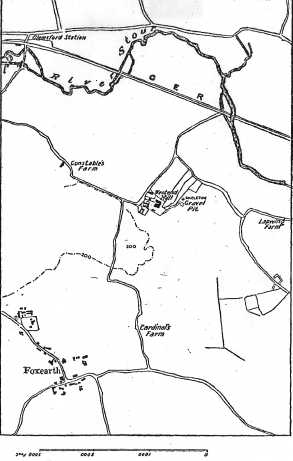
up in a gravel-pit. The pit is situated two hundred yards east of Western Hall, just over the
Foxearth boundary in the parish
of Liston, in Field No. 25, and shown on Map vi. 6, 25 inch Ordnance Survey. (See Fig.
1.)
This
gravel-pit has been open for some years. The workman referred to was digging and carting
gravel therefrom, and was
searching for something to block the wheel of his cart, when he picked up the skull, thinking that it
was a great stone. The inference is that the skull slipped down
with part of the cliff during
the excavating operations. The floor of the pit is about 12 feet deep at the spot. When found the
skull was encased in loam with
fibrous roots in the cavities ; it was in nearly perfect condition, ihe lower jaw being in position,
and the set of teeth perfect, although by an unfortunate accident
the skull was dropped, thereby
detaching the jaw and knocking out one of the teeth.
The
presence of the fibrous roots led me to suppose that the original resting-place of the skull had
been somewhere near the upper
surface of the wall of the pit. I carefully examined the face of the pit, but could find no
trace of any place where the skull had lain, nor could any pottery or
worked flints be dis. covered
in the cliff or in the loose debris.
The
geological character of the earth in which the pit was made is Glacial-drift, but whether any part
of the upper surface is
Post-Glacial I am not qualified to determine. The beds are composed of chalky gravel with patches or
seams of coloured and white
water-washed sands and a small layer of water-worn chalk nodules and some fossils and shells. I
should say the beds are false-bedded, the lines of bedding being
much curved and contorted, and
towards the top or surface of the pit there
are |
![]() |
||
|
Fig. i.—portion of ordnanck map (fsskx vi. 6, 25 inch scale),
SHOWING POSITION OF GRAVEL PIT AT
FOXEARTH |
|||
|
|
|||
|
|
||||
|
alternating beds of sand and
loam. There is very little soil, and what there is consists of brown
stained loam or brick-earth containing
fragments of land shells. In no case is it more than 18 inches
thick, except where there are several small pipes or patches of loam. In other places the
glacial gravel and sand comes to the surface.
The surface of the land above the
pit is about 165 feet O.D., on the southern flank of the valley
overlooking the River Stour, from which it is distant about 400 yards, and
is about 50 feet above the floor of the main valley. As the pit is
practically all Glacial-drift, it
immediately occurred to me that a skull found in such a formation
might be of remote antiquity, or even of Glacial or Post-glacial
origin. |
inches from the upper surface, a
human skeleton. By a careful excavation the greater part was got out, and
I now exhibit it. On. further examination I found indications of
disturbance of the soil, and the
position of the skeleton was not altogether in parallelism with the
lie of the formation. I presumed, although there is no direct evidence,
that the skull and other parts of the skeleton belonged to the same
individual.
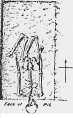
The body seemed to have been placed
in the ground without any rite or ceremony, and appeared to have lain face
downwards. The lower part of the legs appeared doubled up under the body,
but I could not find parts of the
feet. The vertebra also appeared to be twisted. The body lay N. and
S., the head being south.
It should be
added that the site of the pit is at
a point formed by the
intersection of a small
cross-valley, at right angles to the main valley, and it
commands a considerable
view—just such a spot where one
would expect to find a tumulus
or
ancient burial-ground, but
no-
trace of any
such works could be
discovered.
FIG 3—plan of
grave,
The above facts seem to.throw showing'position of .skeleton. doubt on the hypothesis
that
the remains had any direct
connection with the Glacial formation in which they were embedded. But having
found the skull in an
environment of Glacial-drift, I may be pardoned in having been at
first inclined to throw out a suggestion of Glacial or Post-glacial origin, as it appears probable
that man existed as far back as
the Glacial Period. A consideration of the facts, however, seems to
indicate that we have here remains of a later origin. I have presented the
skeleton to the Essex Museum of Natural History, so that it may be
preserved for future study by some competent craniologist.
![]() |
|||
![]() |
||||
|
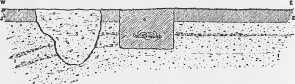
K1G. 2.—.SECTION OF FOXEARTH GRAVEL PIT.
/. Glacial Gravel and Sand. |
||||
|
2. Surface soil,
about 4 to 6 inches.
3. Pipe of Loam and Gravel
mixed ;
j. Grave; soil 1 and 2
mixed. |
Also Brick Earth. |
|||
|
I
submitted the skull to the late Prof. Charles Stewart, F.R.S., of the College of Surgeons, who
pronounced it to be a fine specimen, probably very old. Later, he
wrote expressing the opinion
that it was " Ancient British," whatever that phrase may mean. He appeared to base that opinion
on the assumption that the
cranium came from a shallow depth beneath :he surface, as indicated by the
loam and fibre adhering to it. Several other anthropologists to whom I
have shown it are of opinion that the skull is of an early
type.
'
Later, I
visited the pit again, making a further search for pottery or oiher objects, quite
unsuccessfully. But on examining the cliff face I found imbedded in the
formation, at about 17 |
||||
|
|
||||