The Foxearth and District Local History Society

Cavendish Pictures

A collection of old postcards of past Cavendish

Home
Foxearth postcards and photographs
Ward's Brewery postcards and photographs
Belchamp postcards and photographs
Old postcards and pictures from Glemsford
Pentlow postcards and photographs
Borley postcards and photographs
Liston postcards and photographs
Long Melford postcards and photographs
Clare postcards and photographs

To get pictures of a size suitable for printing or close inspection click on the picture or the accompanying text. Please remember that we are very much on the lookout for pictures of old Cavendish in order to make a comprehensive collection here.
The photograhs themselves are scanned in sufficient quality to provide an A4 photograph is a quality that is almost indistinguishable from the original

fivebellsPub.jpg
The Five Bells pub, named after the five bells of the nearby tower of St Mary's Church, was a well-known landmark. This photo was taken just after the felling of one of the huge poplar trees that once graced the front."At the top of the Bells garden, on the Green, stood the Cage and stocks where they put people when they were drunk. At that time the public houses were open all the Sunday morning until two o'clock. When we came out of our church we could always see men rolling up and down streets drunk"
trainToClare.jpg
The train from Cavendish on its way to Clare about to cross over the river
bridgestreet.jpg
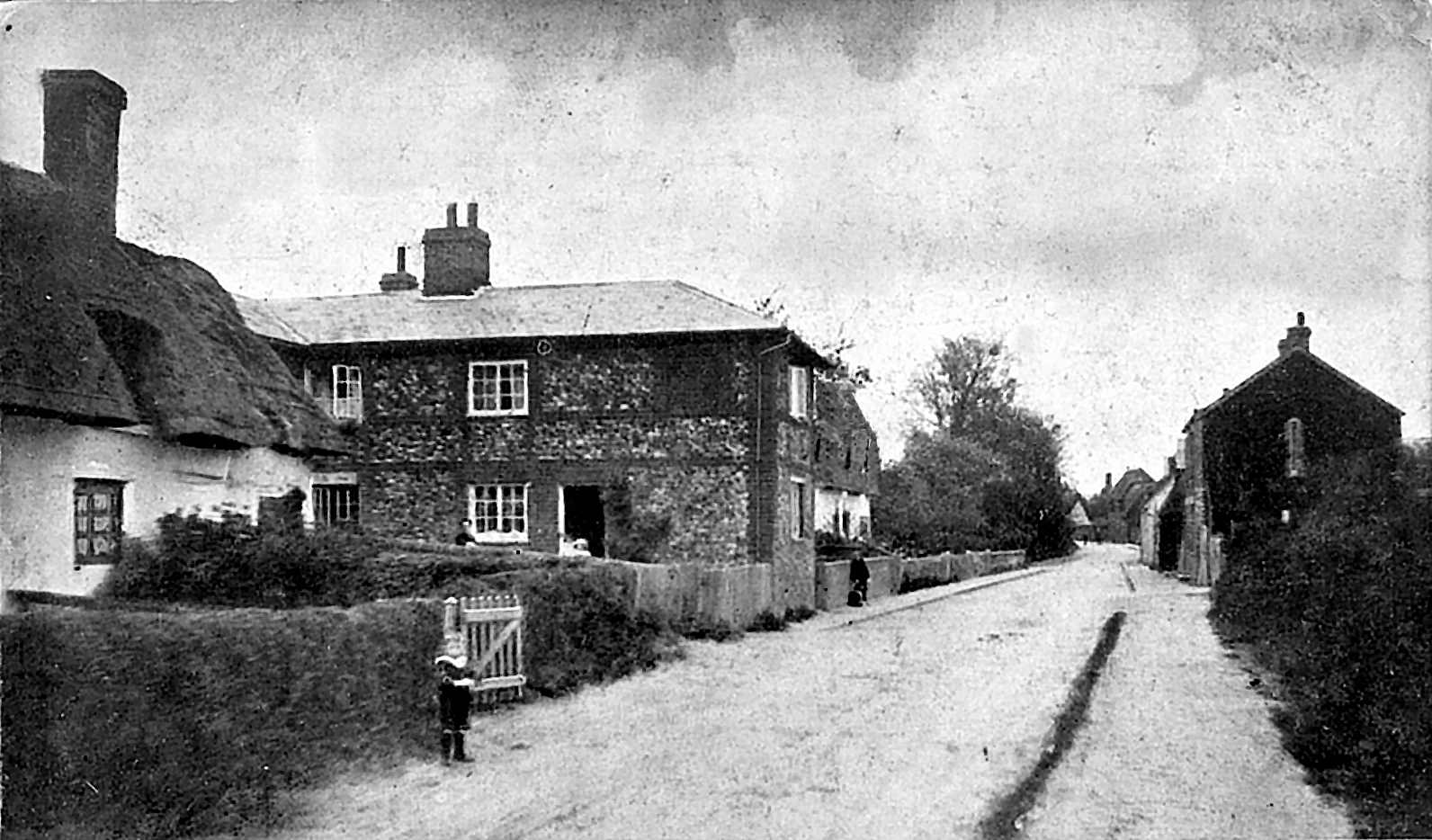
This part of the village was known as Chapel street. The little thatched cottage was owned by Mr Hales' aunt and she sold meat from his shop there. In 1972, the road was widened, and the houses in the centre of the photograph ware, sadly, demolished, along with the ancient bridge which was replaced by a culvert
CavendishSchool.JPG
Cavendish National School, overlooking the green. Mr Stammers of Cavendish was the builder. 'a spacious room 54ft by 18ft flanked on one side by a class room of 15ft by 14ft. The school Mistresses's house formed the other gable.
LowerRoad.jpg
The Lower Road, looking east, showing the Chapel with its magnificent lantern. The United Reformed Church was erected in 1858 by Joseph Garrett, who was a dedicated Congregationalist. He was the son of the Miller at Pentlow Mill who went on to create a large number of Malting and farming businesses."In my young days that was very strong, very often it was difficult to get a seat. "(F Hale)
cottageonwaterlane.jpg
The cottage on the corner opposite the old bridge where Water Lane joined Lower Road was once a butchers' shop. "On the corner of Water Lane lived my aunt, she used to sell a little meat which we sent down from the shop." (F Hale). It was much photographed by day-trippers on their way from the station to the green, until eventually demolished by crazed planners in a road-widening scheme. On the right is the Congregational chapel built in fine style with financial help from Samuel Garret.
theTerrace.jpg
A fine terrace with unusual bay windows, built by Samuel Garrett as homes for his staff at the Maltings. It consists of five homes.
pond.jpg
An interesting early view of the High Street, probably in about 1880, showing the pond, and the entrance to the Old Rectory. The big shop was a grocers shop (run by Mr. Clark, which had once belonged to the Jays "They were woollen manufacturers. Mr. Philip Jay was master when I began to know anything about the place. Mr. Clark's warehouse was called the yarn shop. Thos.Eavens was foreman for him and the women went to him for the wool to spin and brought the yarn back to him when they had done it and weighed it and paid them for it." (J Braybrooke)
highStreetCavendish.jpg
A splendid view of the High Street, looking eastwards, showing what was once the Western House Inn, on the Bristol to Norwich run, but then a private school run by the daughter of Samuel Garrett. In the foregound was once a sweet-shop.
LowerRoadFromViewFromClareRoad.jpg
A detail of the Lower Road, showing Mr Page's builders yard with the long scaffold poles, and the Congregational Chapel in the dstance.
Grammerschooletc.jpg
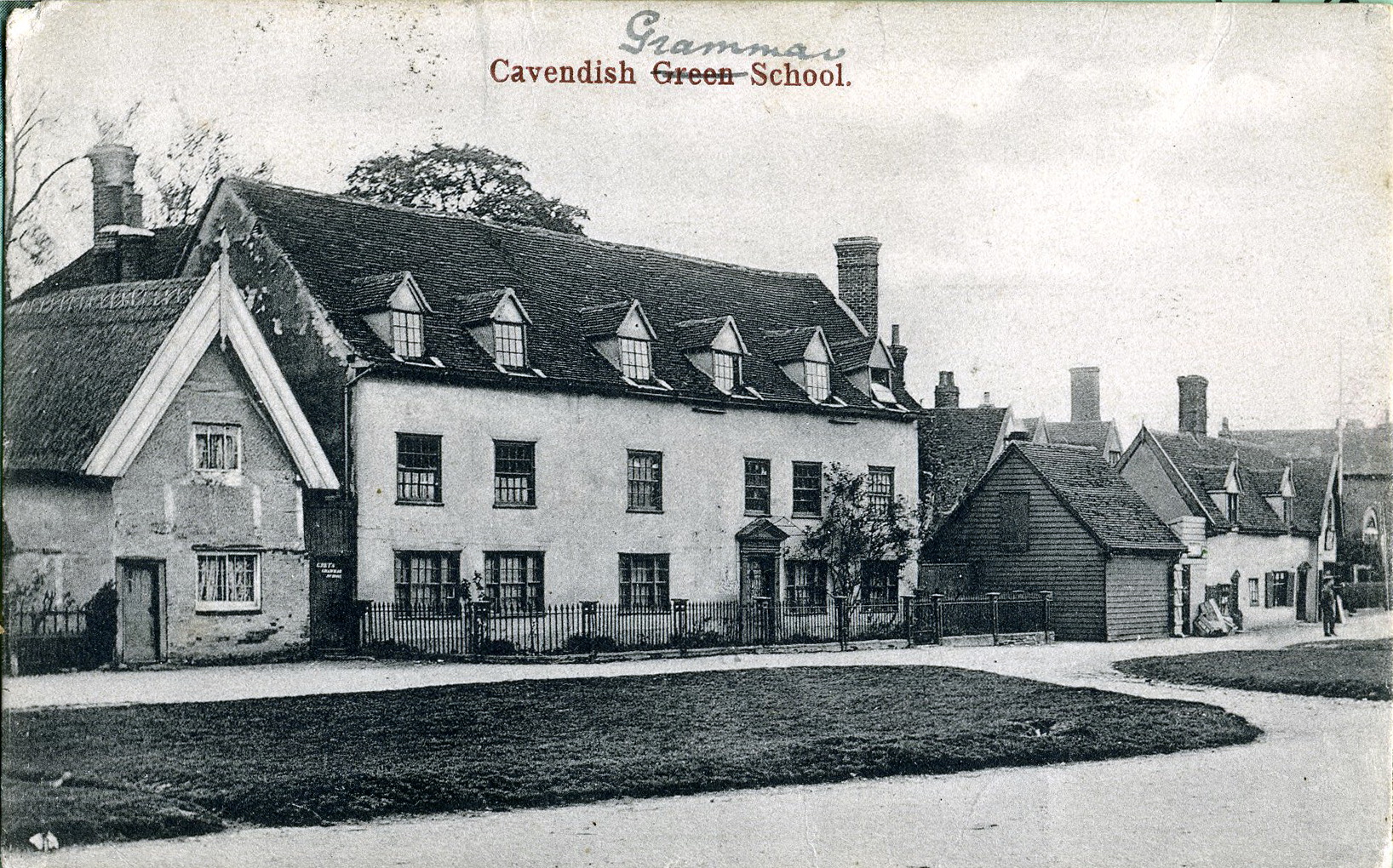
A good shot of the Grammar Schol before it was unceremoniously chopped in half to make a Cinema, but showing the shop now known as the 'Duck and Grouse' together with Mrs Balthrop's shop and the Reading Room.
TheGreenAndChurch.jpg
Cavendish Church viewed across the green some time between the Wars
warmemorial.jpg
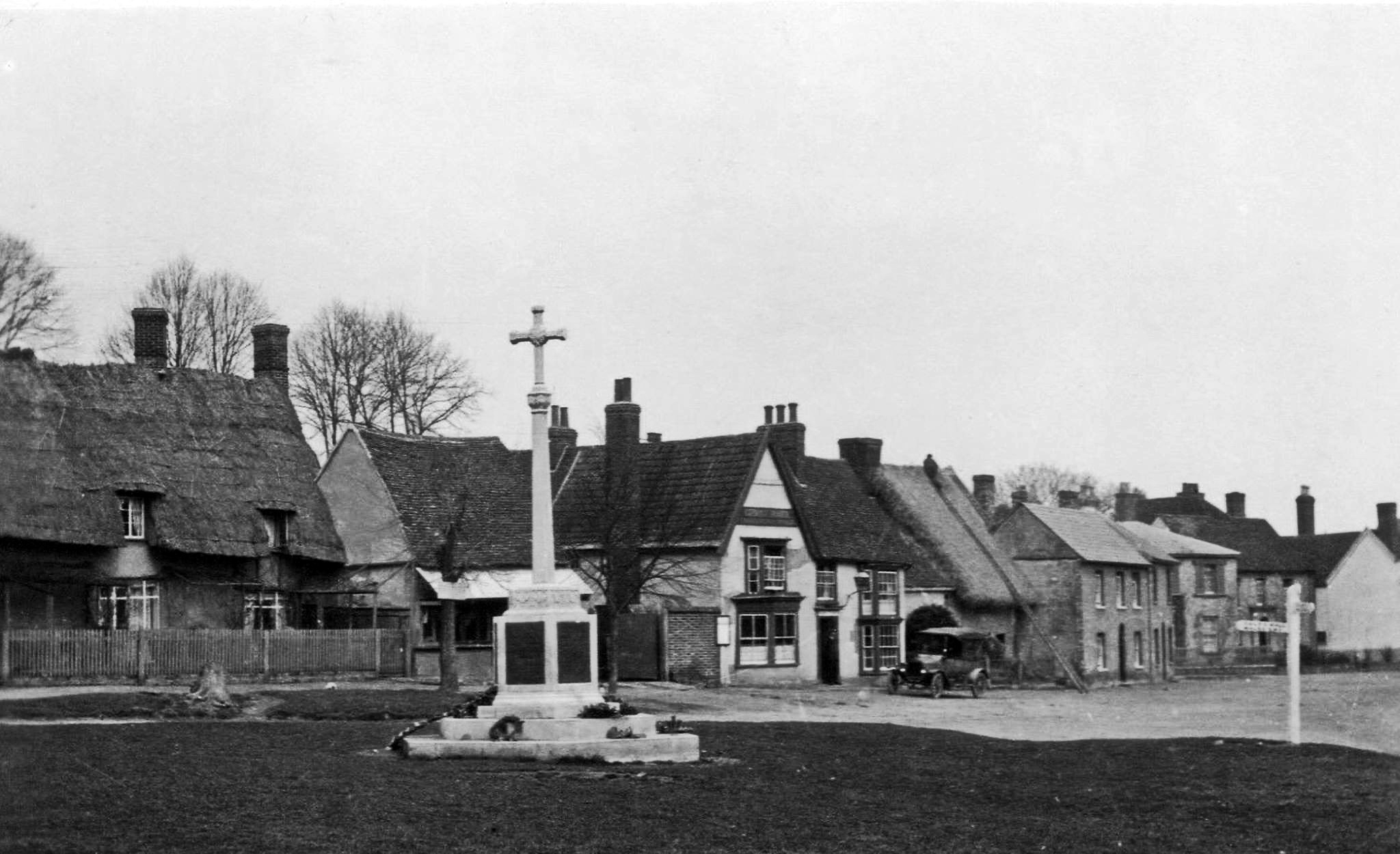
The newly-built war memorial stands on the green
HydeParkCorner.jpg
Hyde Park Corner with the church beyond. A view which featured on many a card and chocolate box
lowerRoadFromWest.jpg
A rare viw of the lower road before the road-widening sceme which spoiled a lovely part of the village. One can see that the village ceased at the Railway Arms, and the junction with the Pentlow Lane, beyond which stood the Railway Station
HydeParkCornerAndChurch.jpg
A Tinted view of the Hyde Park Corner.
viewacrosssthegreen.jpg
A popular view of the green, showing Stour Street in the distance
lowerstreet.jpg
The lower road, looking toward the green
.ParkLane.JPG
Hyde Park Corner Cottages, dating from the 16th century, appear on calendars the world over. They were nicknamed 'Hyde Park corner' because of the practice of visitors at the rectories in engaging in outdoor preaching in that part of the Village green. They have twice been rebuilt.
thegreen.jpg
The green, in a view showing 'Hyde Park corner' and the church. The sheep were once a characteristic part of the scene
FrankHalesShop.jpg
Frank Hales' butchers shop is an ancient building dating from 1500. It was a butchers shop from 1790 to 1986.
barlthrop.jpg
Mrs Balthrop proudly stands outside her shop. She is remembered with some awe as she was rather eccentric and smoked a pip upside-down. Someone seems to have thrown a stone through the bedroom window. The Blacksmiths shop was set back between the two buildings
CavendishFire.jpg
The destroyed houses which once had been 'Hyde Park Corner, the morning after the fire. They were subsequently rebuilt.
cavendishMilkman.jpg
The Village milkman
thepondAndhighStreet.jpg
The High Street, showing no signs of traffic, and a road that was not yet tarmac.
ALittleBitOfOldCavendish.jpg
'A Little Bit of Old Csvendish.
pooleStreetCouncilHouses.jpg
The Council Houses of Poole Street. A slightly surprising subject for a postcard, but they were substantial, wel-built houses with gardens of a wonderful size, sufficient for a family to feed themselves from
railwaylevelcrossing.jpg
The last passanger train goes over the level crossing into the station
hales.jpg
Mr F Hale, the butcher in his delivery cart outside the Butchers shop. The lovely old oak cachiers booth from the butchers shop survived until last year when it was destroyed during renovation work
oldRectory.jpg
The only picture so far found of the Old Rectory, a suberb house which eventally became the 'Sue Ryder' home. The house itself suffered in the transformation, becoming surrounded by unsighly extensions. Hopefully, one day it will be renovated
CavendishStation2.jpg
Cavendish Station in the 1950s. The view hardly changed throughout its' life. "I've seen 100 people come off the trains there at holiday time," (F Hale)
PaddockMillBridge.jpg
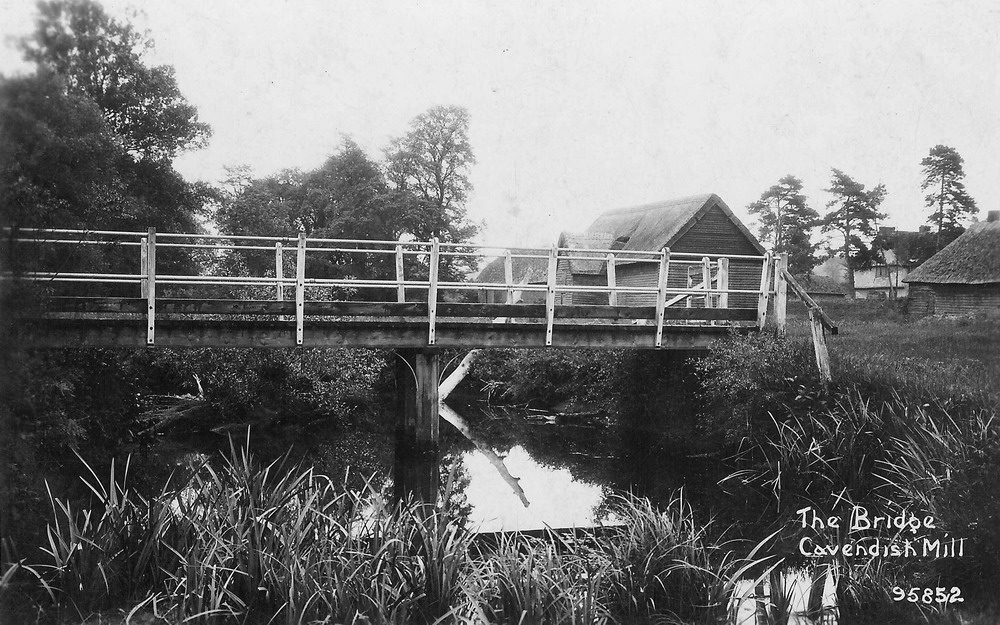
The footbridge over the Stour at Paddock Mill (Cavendish Mill)
LowerRoadFromRailwayArms.jpg
The top of the lower road looking toward the west, showing the edge of the Railway Arms pub on one side and builders yard on the other. In the disrtance is the chapel.. Nowadays, a photographer standing in the same place would be infear of his life.
BullAndGreen.jpg
A fine fiew of the High Street before the First Worlk War.
TheHighStreetCavendish.jpg
The high street, looking eastwards towards Long Melford
river.jpg
An unusual view of the village taken from the edge of the watermeadow to the west of the village, opposite Hullets' wood and Ash Grove. The river diverges at this point, a wier feeding the original river to the left, and the rest becoming the Leat for Pentlow Milll
cyclingAroundTheGreen.jpg
An Edwardian photograph, showing some young people engaged in the popular sport of cycling. There is little evidence of cars. The road was then quite narrow at this pont
cavmisc10.jpg
The 'Grapevine'.
TheGreys.jpg
The Greys.. In the distance is the beautiful thatched barn that then belonged to butchers' shop It was subsequently demolished to make way for housing despite the frequency of flooding in the area. by the river
thepond.jpg
An interesting view of the high street showing the grant twin entrances to the Old Rectory, marked on the old maps. The two driveways were necessitated by the difficulty of turning a horse and carriage.. The pond, now sadly shrunken, lay between the two gates. It was once fed by an open stream that ran across the road a this point, long since diverted into a culvert
TheStreet.jpg
A view from the west of the chapel towards the green
oldRectoryOverhall.jpg
OverHall, at the time that it was the rectory
overhall.jpg
Over Hall, when in use as the vicarage
drritchieonStarlight.jpg
Dr Richie proudly poses on a very fine horse outside the stables of his house
StourAboveHullets.jpg
The river, probably the stretch betwwen Pentlow Mill and Cavendish(paddock) mill, with Paddock Mill in the distance
cavendishstation4.jpg
A goods train passes through the station with a horsebox
Blacklands.jpg
Blacklands Hall is a mediaeval building with several later rebuildings. It was the seat of the Ruggles Brise family Joseph Stammers Garret lbought it from them in 1853. Blacklands Farm was one of the largest in the area.
oldPostOffice2.jpg
A one time, cameras and photograhers were a fascination. Here is the view from the top of the high street toward the lower road.
theWhiteHart.jpg
One of the best existing photos of the White Horse Inn, showing what a fine building it was. In the distance, on front of a hoarding protecting some building work, stands a dwarf.
totheGreenFromStourstreet.JPG
A cottage, now long gone, which was to the side of the butchers shop. This was once a popular view of the village.
CornerOfGreen.jpg
The road out of Cavendish, led out to some allotments and, after a gap, a hamlet once dominated by the parish workhouse and the FirTrees pub and barbers shop
byford.jpg
Byford was a Cavendish rcarrier who, before the railway came, did the journey to London and back twice a week. He then moved to Glemsford and specialised in Furniture removals.
HydeParkCornerCottages.jpg
Hyde Park corner cottages, in the 1920s when lived-in by ordinary village families.
bullhotel2.jpg
The Bull Hotel, when it was a Wards Pub, owned by the famous Foxearth brewery. The White Horse next door had gone by the time this photo was taken
belleVue.jpg
Belle Vue Villas later became a butchers shop. Now it is a Post Office. It has kept its jaunty continental flavour with its characteristic balcony
RailwayArmsCavendish.jpg
The Railway Arms was built on the site of a previous house, as a speculation when the railweay was being constructed. Its architecture was urban in anticipation of a building boom that never materialised, though the pub did well with summer trippers who arrived in great numbers up to the Second World War."The house on the right hand side, where the Railway Arms stands, Thomas Skilton lived. He was a big man and gardened a little field. It was called Towne Field. It was by the side of Water Lane and went up to the house that stands by the path that goes up by the fields" (J Braybrooke)
Carter.jpg
A carter drives his waggon down an otherwise-deserted high street at Cavendish on a clear winters' day in 1903
church.jpg

trainLeavingCavendish.jpg
The Marks Tey-Cambridge train in 1951 hauled by a Holden E4 Intermediate, heading towards Clare alongside Stour Street.
pentlow Bridge.JPG
Pentlow Bridge was built on the site of several previous bridges in the 1880s. It was built to take the weight of the lage ploughing engines which were coming into use at the time and so is extremely substantial.
RiverStour.jpg
The River Stour, looking from the edge of the station across toward Pentlow Hall
pooleStreetCottages.jpg
Workhouse Street, later called Stour Street.
highStreetCavendishWithBullHotel.jpg
The High satreet on a sunny winters day some time in the 1930s
the station  and path to mill.JPG
A tineted photograph showing the Railway Station and Pentlow Bridge taken from the meadow in front of the mill. It shows a well-worn path used by mill-eorkers.
railwayTracks.jpg
The railway line somewhere between Cavendish and Clare
ColtsHall.jpg
A rare picture of Colts Hall Farm, Cavendish.
greenandchurch.jpg
The view of the church tower from the start of workhouse lane, before a road-widening scheme demolished much of what was picturesque in this part of the village.
cavendishStation.jpg
A fine Holden 2-4-0 tender engine sets off from Cavendish station in pre-grouping days with a substantial 5-coach train behind it.
HydeParkCornerColour.jpg
'Hyde Park corner' after its' first restoration
HydeParkCornerRenovation.jpg
The Hyde Park Corner houses having their first restoration. The roof timbers being used seem surprisingly insubstantial,
StationLookingWest.jpg
The immaculate platform of the Railway Station, planted with ornamental shrubs. One can just see Pentlow Mill in the distance and Hullets Wood on the horizon
StourStreetCottages.jpg
A closeup of cottages in Stour Street
Thatcher.jpg
A thatcher attends to the roof of the cottage next to the George Hotel. A model T ford car is parked proudly outside the George
GeorgeHotelFromGreen.jpg
The photograher must have been perilously near to the pond to take this photograph of the George Hotel
ponyandtrap.jpg

grammarschool.jpg
The Grammer school existed from 1696 to 1907, and housed boarders as well as dayboys. In 1935, the owners demolished the school side to make space for a Cinema. It was a terrible loss in architectural terms, but the cinema was a great benefit.
outsideTheFiveBells.jpg

WBrownsShop.jpg
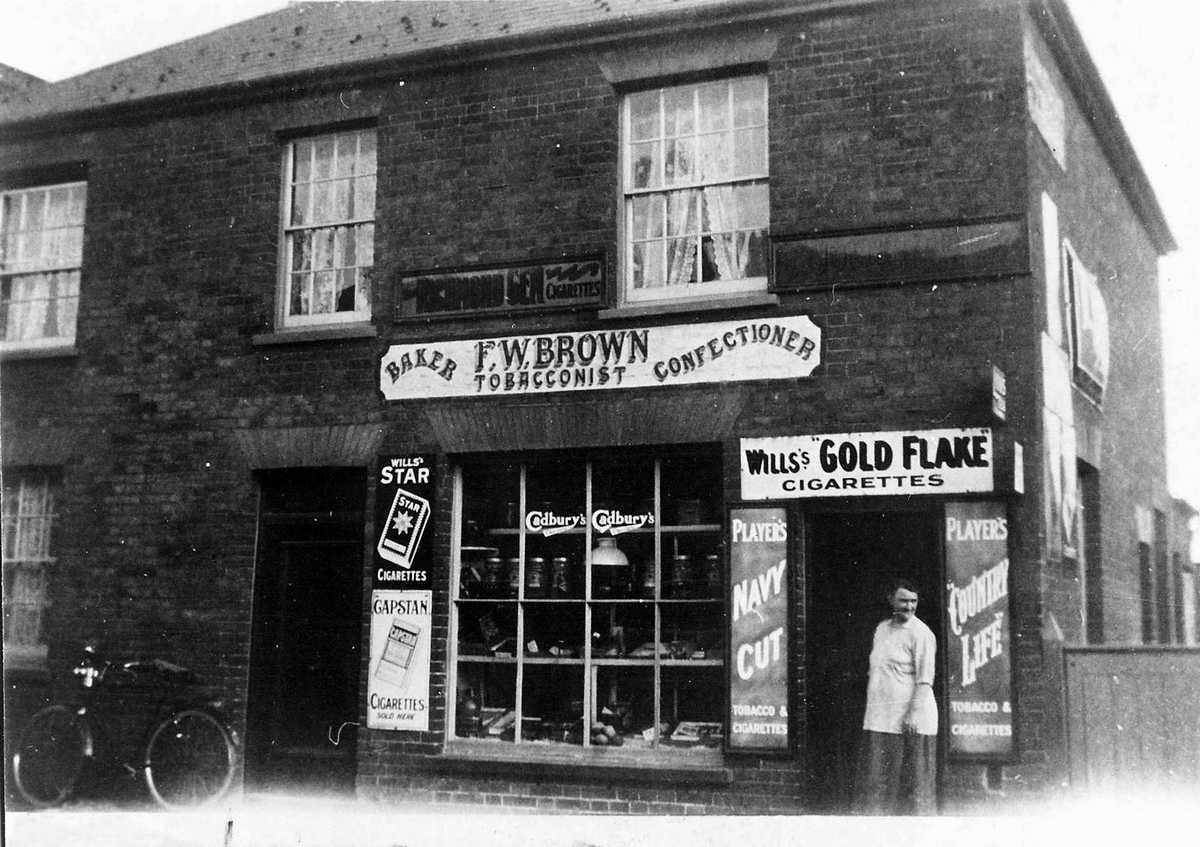
This photograph of Mr F W Brown's shop dates from 1925, and was one of 25 shops that existed in Cavendish at the time. The house still exists in the high street opposite the post office
nearcavendish2.jpg
On the road from Water Lane to Blacklands
Grapevine.jpg
The grapevine used at one time to be a school
BillTharby.jpg
Bill Tharby, Cavendish Signalman who retired after 53 years' service on the railways, standing in front of the level-crossing gates at Cavendish Station
TheGrapeVine.JPG
The 'grapevine' showing the path across the green to the butchers' shop.
ClareStation.jpg

HalesBarn.jpg

theriver.jpg
A tinted photograph of the Stour taken from Hullets Wood, and showing the railway reack in the distance deliniated by a neat hedge
Waterlane.jpg
An interesting photo of Cavendish High Street, with the old bridge over the stream. Note that the road is 'soft', but electricity has come to the village
StationAwningFromPlatform.jpg

Bullhotel.jpg
The Bull hotel, taken ofn a fine summers' day
CottageInPeacocksRoad.jpg
The old cottage in Peacocks Road
cavendishChurchRecent.jpg

CavendishHall.jpg

firtrees.jpg
This pleasant building, opposite the old workhouse, was once a farm cottage, but was, for some time, the fir Trees pub and barbers' shop. It has since reverted to being a private house
stourstreetview.jpg
The View from Stour Street past the old workhouse
CavendishFromTheHullets.jpg

OnTheCavendishRoad.jpg
Cavendish End, seen from the gates of Cavendish Hall. The farm house on the left of the picture is Kings Farm, later called Yew tree house
fivebellsRequiem.jpg

Bullards.jpg
The five Bells pub was almost completely rebuilt. This photograph shows the original. Fortunately, the replacement was well-designed and thatched so as to fit in with the surroundings.
NewFiveBellsAndChurch.jpg

DrRichie1903Blacklands.jpg

georgehotel.jpg
The George Hotel, On the left was the garage and village petrol pump. It had previously been a butchers shop owned by Mr, Wm. Orbell's. "He did a very large trade there then. There were four or five very big tall poplar trees stood before the house and shop then. He had wood from one tree up to the big one with hooks in and, twice in the week in the season, there would be one, and sometimes two, calves hung out there to be sent to London " (Wm Braybrook)
readingroom.jpg
This is a house of fabulous quality, once owned by the Cavendish family. the photograph shows it in its time as Cavendish's institute and reading rooms.
cavendishManor.jpg

oldPostOffice.jpg
The earliest surviving photograph of Cavendish is also rather mysterious. The location of the building has not been satisfactorily identified.
fromthepond.JPG
The village pond, in an edwardian photograph. The pond still exists, but in a sadly truncated form.
AshGrove.jpg
A distant view of cavendish from Hullet's Wood to the west of Cavendish. The railway line can be seen ias a long hedge. The meadows were used for grazing.
CavendishFromTowerHeading.JPG
A pre-WW2 colour photograph of Cavendish taken from the top of the church tower.
TheGeorge.jpg
The George Hotel, showing some elm trunks on their way to the sawmills. On the left is the butchers' shop
cavendishTumbril.jpg
A young Stan Thompson on a haycart
HydeParkCornerCottagesCloseup.jpg
The original 'Hyde Park Corner cottages whilst they still retained all their charm. It would seem that there were at least seven dwellings in the row at the time.
cavendishPostOffice.jpg
Cavendish Old post Office, from 1913. It is now a private house.
readingRoomAndLibrary.jpg
Cavendish Manor led an undignified life in the nineteenth century. It is the finest building in Cavendish, but it eventually decayed into cottages until it became a Reading Room and Institute "... where as a young man I used to go. We played draughts, dominoes, billiards, and read papers. there were weekly magazines there, and that was also where the village paper was sold. "(F Hales)
HorsesAtHydeParkCorner.jpg
The site of the war memorial
schoolCricket.jpg
The children used the top of the green as a playing field, and here a serious game of cricket is being played
railway.jpg
A train from Clare passes over Stech Meadow, and approaches the level crossing before the station.
SchoolBoysCavendish.jpg
The lads at Cavendish School drilling with fake guns, probably during World War One
netherhallFront.jpg
Nether Hall, in its glory days as the headquarters of Cavendish Vinyards.
school.jpg
Cavendish Schools at the top of the village green
cinema.jpg
The cinema was a popular introduction. The old Grammer school building found a transition to a private resident difficult and the owners finally demolished over half of the frontage and built the cinema.
cavendishEnd.JPG
The view from Yew Tree House towards the old workhouse. Cavendish End was always a separate hamlet, joined to the main village by workhouse street (later called Stour street)
paddockMill.jpg
Paddock Mill enjoyed considerable prosperity for a while. The mill is eighteenth century and was never converted to take roller mills and so its trade petered out into animal feed before it ceased to function in the 1930s. The House survives but the mill itself is long gone. Originally, it was called Paddock Mill, but the name became corrupted to 'Paddy's mill. This became 'Patrick Mill' and mor recently 'Cavendish Mill'.
CricketTeam0.jpg

cricketTeam1920.jpg
Cavendish Cricket team from 1920
1923TenniscLUB.jpg
The Cavendhsh Tennis Club, which used to play in tennis courts behind the Grays
TheRectoryCavendish.jpg

workhouse.jpg
The original Parish Workhouse. It has now been demolished. When the poor Laws were enacted, the parishes relinquished responsibility for looking after the poor and needy and they were sent to the union workhouse in Sudbury. The Workhouse was sold and became private houses
cricketground.jpg
The Cavendish Cricket ground.
butchersshop.jpg
Mr Chinnery proudly stands outside his butchers' shop
ChinneryButchersShop.jpg
Belle Vue Villas became a butchers shop . This picture was taken on a snowy day. The dog affects an indifference to the meat on display.
nearCavendish.jpg

bull.jpg
This photograph of the Bull inn was taken in 1929. It has changed little since but has lost the elaborate porch on the right of the building.
netherhall.jpg
Nether Hall, near the church, is a tudor building on the site of a much older manor.
PeacocksRoad.jpg
The view up Peacocks' road
stourstreet.jpg
Stour Street, looking towards Cavendish Hall.
postOffice.jpg
The old Post Office in the 1930s
CavendishMill.jpg
Paddock Mill, Cavendish, later known as Patrick Mill, and finally Cavendish Mill. By the time this photo was taken, the mill itself had gone, leaving just the mill House. Judging from the car in the distance, this photograph was taken in the late 1930s
BullAndWhiteHorse.jpg
The White Horse pub had a great effect on Cavendish's high street and its loss was sad. This photograph was taken some time around 1910, and shows the road still its unmetalled state.
fiveBells.jpg
A view of the old Five Bells public house, named after the bells of the adjacent church.. The pub was later rebuilt.
CavendishGreenBeforeWW1.jpg
A view of cavendish from the green towards melford. The photograph was taken before the First World War
DucksHall.jpg
Ducks Hall, before its 'renovation', when it was two cottages.
CricketTeamc1930.jpg
The Cavendish Cricket Team, with Basil Ambrose's father taking centre stage. We would dearly like to know the names of the others on the photograph
CricketTeam1.jpg

DucksHall2.jpg
Ducks hall
childandFiveBells.jpg
The original Five Bells pub
cavendishstation3.jpg
A view of Cavendish station taken from the signal box "On the ground where the station stands now, there was a farmhouse and house stood. It was called the Great House Farm. Mr. James Hickford held the farm and had a dairy of cows and sold the milk and butter to that part of the village. That farm had land on both sides of the road as far as the brick kiln." (J Braybrooke)
JustACardFromCavendish.jpg
A postcard from the twenties. Ironic it is to notice that two of the four picturesque views of Cavendish have now been destroyed.
greetingsFromCavendish.jpg
Greetings from Cavendish, with a montage of local sights
BlacklandsHall.jpg
Blacklands suffered from some rather unrestrained makeovers by Victorian Architects Beneath the mock gothic lies a fascinating mediaeval house.
StationPlatform.jpg
Cavendish Station, looking toward Glemsford. The land has now become back-gardens
paddockMillsluiceGates.jpg
Paddock Mill sluice gates. The photograph seems to date from around 1900
NewFiveBells.jpg
The new Five Bells Pub, a photograph taken soon after its rebuilding. Mercifully,the thatched roof, so characteristic of the old Five Bells, was used for the new building.
CavendishChurchInterior.jpg
A hand-tinted photograph of the interior of the church
SchoolChildrenCavendish.jpg
The Children of Cavendish 'National' School.
ChurchInterior.jpg
The splendid interior of Cavendish St Mary's Church